Posts tagged "Remix"
-
Shopify’s Hydrogen framework now works on Netlify with React Router 7 and Hydrogen 2026.1.0. The Netlify Hydrogen template has been fully rebuilt, and
@netlify/vite-plugin-react-routernow supports Hydrogen sites out of the box.The updated template also comes with two meaningful improvements:
- Netlify Cache API integration — Data fetching is cached using the Netlify Cache API, giving you low-latency responses without extra configuration.
- Full local platform emulation — The Netlify Vite Plugin provides zero-config local emulation of Blobs, Functions, Edge Functions, and AI Gateway during development, so what you test locally matches what runs in production.
To get started with a new Hydrogen site on Netlify, deploy the updated template:

To move an existing Hydrogen site over to Netlify, follow the How to deploy a Shopify Hydrogen storefront to Netlify guide.
Learn more:
-
The React Router team has disclosed six security vulnerabilities affecting React Router and Remix. Here’s what Netlify customers need to know.
Vulnerabilities
Vulnerability Remix versions React Router versions & modes CVE-2025-61686 - Path traversal ≤2.17.1 7.0.0–7.9.3
All modesCVE-2025-68470 - Open redirect - 6.0.0–6.30.1, 7.0.0–7.9.5
All modesCVE-2026-22030 - CSRF ≤2.17.2 7.0.0–7.11.0
Framework onlyCVE-2025-59057 - Meta XSS 1.15.0–2.17.0 7.0.0–7.8.2
Framework onlyCVE-2026-22029 - Redirect XSS ≤2.17.3 6.0.0–6.30.2, 7.0.0–7.11.0
Framework, DataCVE-2026-21884 - ScrollRestoration XSS ≤2.17.2 7.0.0–7.11.0
Framework onlyImpact on Netlify
CVE-2025-61686 (path traversal)
This vulnerability affects
@react-router/node,@remix-run/node, and@remix-run/deno. These packages are not used on Netlify, therefore Netlify projects are not affected.CVE-2025-68470 (open redirect)
Apps with unsafe uses of React Router navigation APIs may be hijacked to redirect to arbitrary origins.
Regardless of hosting provider, all apps constructing paths from untrusted user input may be vulnerable.
CVE-2026-22030 (CSRF)
Actions and experimental RSC Server Functions can be triggered by cross-origin form submissions, allowing an attacker to execute actions on behalf of authenticated users.
Regardless of hosting provider, all apps may be vulnerable.
CVE-2025-59057, CVE-2026-22029, and CVE-2026-21884 (XSS)
These are cross-site scripting (XSS) vulnerabilities. For example, in CVE-2026-22029 actions and experimental RSC Server Functions performing a redirect to a path constructed from untrusted user input may be hijacked to execute arbitrary JavaScript in the browser.
Regardless of hosting provider, all apps passing untrusted data into certain APIs may be vulnerable. (The Remix team has left this intentionally vague.)
What should I do?
If any of your projects are using any affected version listed above, we strongly recommend upgrading as soon as possible to patched releases:
react-router7.12.0 or later (for React Router 7.x)react-router6.30.2 or later (for React Router 6.x)@remix-run/react2.17.4 or later@remix-run/server-runtime2.17.4 or later
Note that any publicly available deploy previews and branch deploys may remain vulnerable until they are automatically deleted. Consider deleting these deploys manually.
-
React Router 7 apps on Netlify are deployed to Serverless Functions by default. Now, you can choose to deploy your app to Edge Functions instead, bringing your page renders, data loaders, and actions closer to your users while lowering cold start times.
How to use it
- Ensure you’re on version 7.9.0 or later of React Router:
npm install react-router@latest @react-router/node@latest @react-router/dev@latest- Update to the latest version of the Netlify React Router plugin:
npm install @netlify/vite-plugin-react-router@latest- Enable the new
edgeoption in yourvite.config.ts(or.js):
export default defineConfig({plugins: [reactRouter(),netlifyReactRouter({ edge: true }), // <- deploy to Edge Functionsnetlify(),],})- Finally, create a file at
app/entry.server.tsx(or.jsx) containing this single line:
export { default } from 'virtual:netlify-server-entry'On your next deploy, page renders, loaders, and actions will all run in an edge function.
When to use it
Choose Edge Functions when:
- You need minimal latency for your globally distributed users (edge functions run on the node closest to the user)
- You need to optimize cold starts (initialization is faster with the slim Deno edge runtime)
- Your data loaders and actions make requests to databases and APIs that are also globally distributed, or none at all
- You need to support very large request or response bodies (Serverless Functions have a 6 MB limit)
Choose Serverless Functions when:
- Your data loaders and actions make requests to databases or APIs that are centrally located (canceling out much of the benefit of edge compute)
- Your server-side code is CPU-intensive (Serverless Functions run on more powerful machines)
- You need longer execution times (Functions allow up to 30s clock time, while Edge Functions are limited to 50ms CPU time)
- You cannot use Edge Functions due to their runtime constraints or limitations
Next steps
- Create a new React Router 7 project with our template
- Read the Netlify React Router plugin docs for more details on deploying to the edge
-
React Router 7 recently launched its long-awaited middleware feature, stable since v7.9.0.
Middleware is now fully supported on Netlify.
How to use it
Ensure you’re on version 7.9.0 or later of React Router:
npm install react-router@latest @react-router/node@latest @react-router/dev@latestUpgrade to version 2 of the Netlify React Router plugin:
npm install @netlify/vite-plugin-react-router@latestAfter that, middleware works out of the box.
Next steps
- Check out the full React Router middleware docs
- Create a new React Router 7 project with our updated template
- Read the Netlify React Router plugin docs for more on loader/action context and to access type-safe Netlify context in middleware
-
We are aware of recently disclosed vulnerabilities affecting React Router and Remix:
- CVE 2025-31137 (React Router 7 and Remix): Spoof request path allowing certain access control bypasses
- CVE-2025-43864 (React Router 7 only): Cache poisoning leading to unusable responses
- CVE-2025-43865 (React Router 7 only): Cache poisoning with arbitrary data
Impact on Netlify sites:
- CVE 2025-31137: Sites on Netlify are not vulnerable, because the Netlify CDN cache varies on the query string by default, and Remix and React Router sites on Netlify do not use the impacted Express package.
- CVE-2025-43864: Sites on Netlify using React Router 7.2.0 to 7.5.1 were vulnerable until 04/27 3:00 UTC. However, exploitation requires all of the following conditions for a given URL to be poisonable:
- The site must not be using React Router’s SPA mode.
- The page or loader must be explicitly setting caching headers.
- A malicious request would need to be the first request to reach the cache (such as immediately after a deploy or cache invalidation).
- CVE-2025-43865: Sites on Netlify using React Router 7.0.0 to 7.5.1 were vulnerable until 04/27 3:00 UTC. However, exploitation requires all of the following conditions for a given URL to be poisonable:
- The page or loader must be explicitly setting caching headers.
- A malicious request would need to be the first request to reach the cache (such as immediately after a deploy or cache invalidation).
We strongly recommend upgrading to the latest versions of React Router (7.5.2).
Given these specific requirements, the number of vulnerable Netlify sites is low. However, out of an abundance of caution, our engineering team is actively rolling out a mitigation to further protect against these vulnerabilities. We will continue to monitor the situation and will provide updates as our work progresses.
Update: As of 2025-04-27 3:00 AM UTC, a mitigation has been rolled out to the Netlify CDN for all vulnerable sites.
-
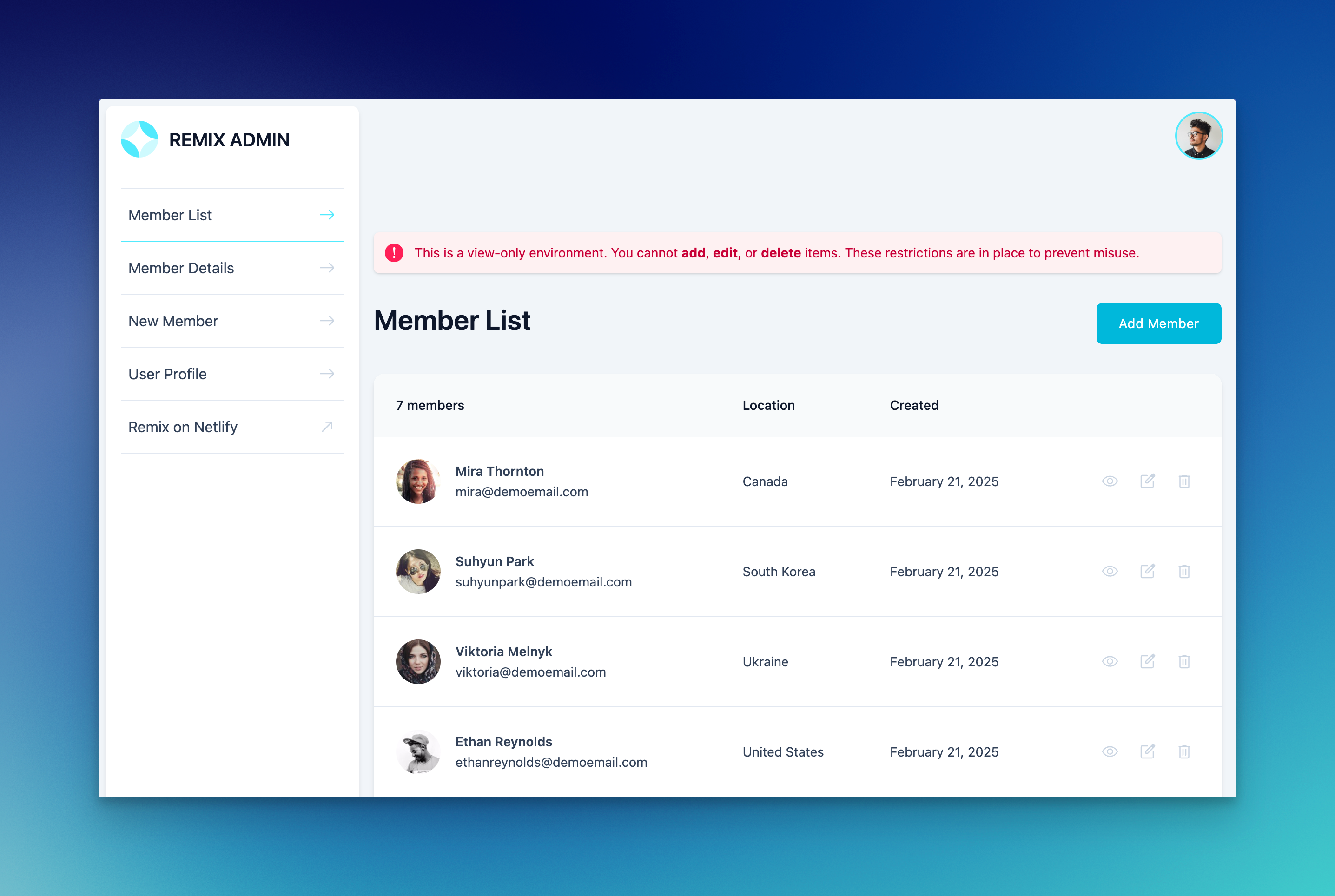
When creating a new site from a template, there is a new option available — Remix Admin Supabase Starter.
This is a simple user admin application with CRUD operations for individual user records. The template is built with Remix and using Supabase as the backend (database) provider.
The repo is available at netlify-templates/remix-admin-template, and you can view a read-only demo here.