A year ago, if you’d told our People team we’d be building our own software, we would’ve laughed. None of us are engineers, but we’ve now replaced our employee survey tool, built custom dashboards instead of purchasing analytics software, and automated manual processes - saving over $10k in annual software costs and reclaiming hours each week. More importantly, we’ve shifted from reactive support to strategic partnership. We’re no longer just answering questions, but designing systems that move the business forward.
Our People team at Netlify consists of four team members: Laura (SVP, People), Kelly (HRBP Director), Jasmine (People Operations Partner), and me, Chelsey (Head of Talent). We lead global talent strategy and people operations for a fully remote team of 100+ employees across 12 countries. Being lean and globally distributed forces you to get creative about how you work and where you invest your time.
We started our vibe coding journey with simple pet projects (literally!) by building playful sites for our pets to learn the tools without the pressure of breaking something important. Vibe coding, meaning using AI to build software through prompting rather than traditional coding, made it possible to watch something functional appear from a few prompts, then go live on Netlify with one click.
That playful, low-stakes lightbulb moment of seeing how easy the process could be helped us realize the huge impact vibe coding could have on our day-to-day workflows. On a distributed team, those clunky problems add up - every ‘what’s the status on that hire?’ or ‘where’s the onboarding doc?’ costs time for our employees, and purpose-built tools could solve these in ways generic software never could. Who would’ve thought that a simple dog site would lead to that realization and evolve into complex internal tools now being used across Netlify!
| Instead of using… | We built… |
|---|---|
| A survey platform | A custom internal pulse tool |
| A hiring analytics tool | A tailored dashboard for our leaders |
| Another onboarding SaaS product | A gamified training experience |
| A hiring enablement platform | A self-serve onboarding experience |
This blog is the story of where we started and where we’re headed. I’ll walk you through three perspectives: how our talent team uses vibe coding, how our business partner and ops teams have shipped tools that solve real pain points, and what we’ve learned along the way as a scrappy People team taking an iterative approach to building our own tools.
Apps from the Talent Team
Supporting Netlify’s hiring, I’d been using AI in various ways, such as custom GPTs for reinforcing structured interview loops, stress testing role definitions, analyzing interviews to surface misalignment in assessments, and systematizing sourcing, to name a few.
Those tools were helpful, but vibe coding was different. It gave me the ability to own my tools and build exactly what I needed, rather than work around the limitations of existing software.
Hiring manager enablement app
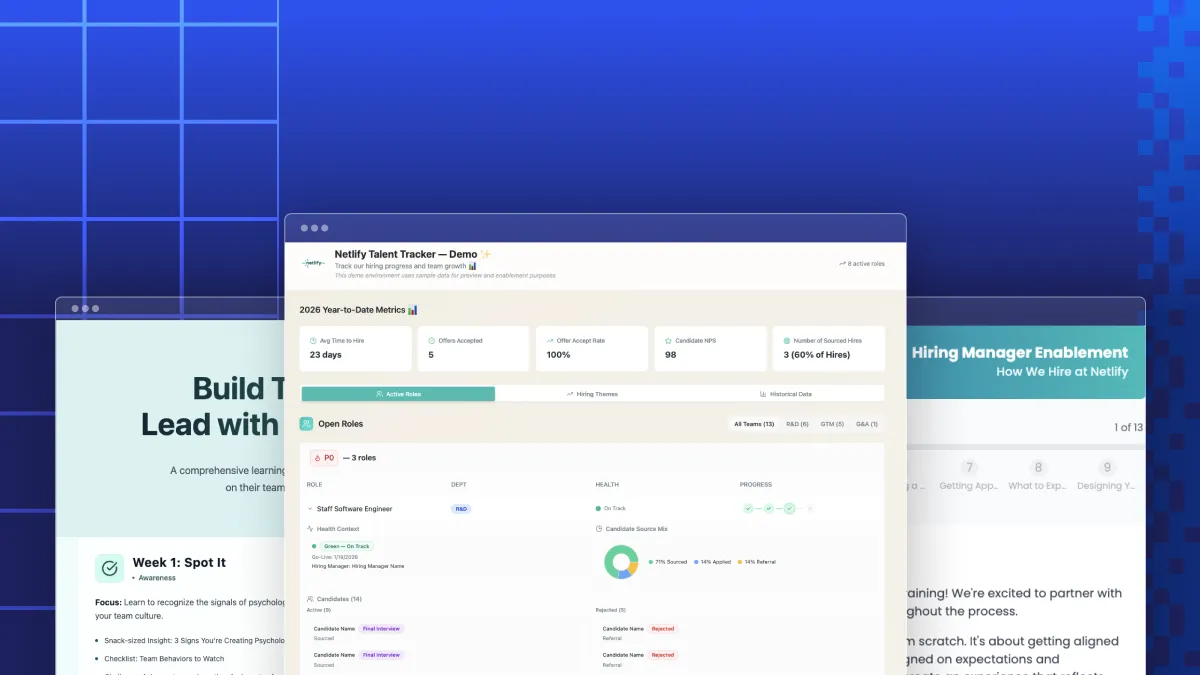
My first internal vibe-coded project was a hiring manager enablement tool. Before this tool existed, I was spending several hours at a time enabling new hiring leaders individually on our hiring principles, how to open roles, and what structured hiring actually means.
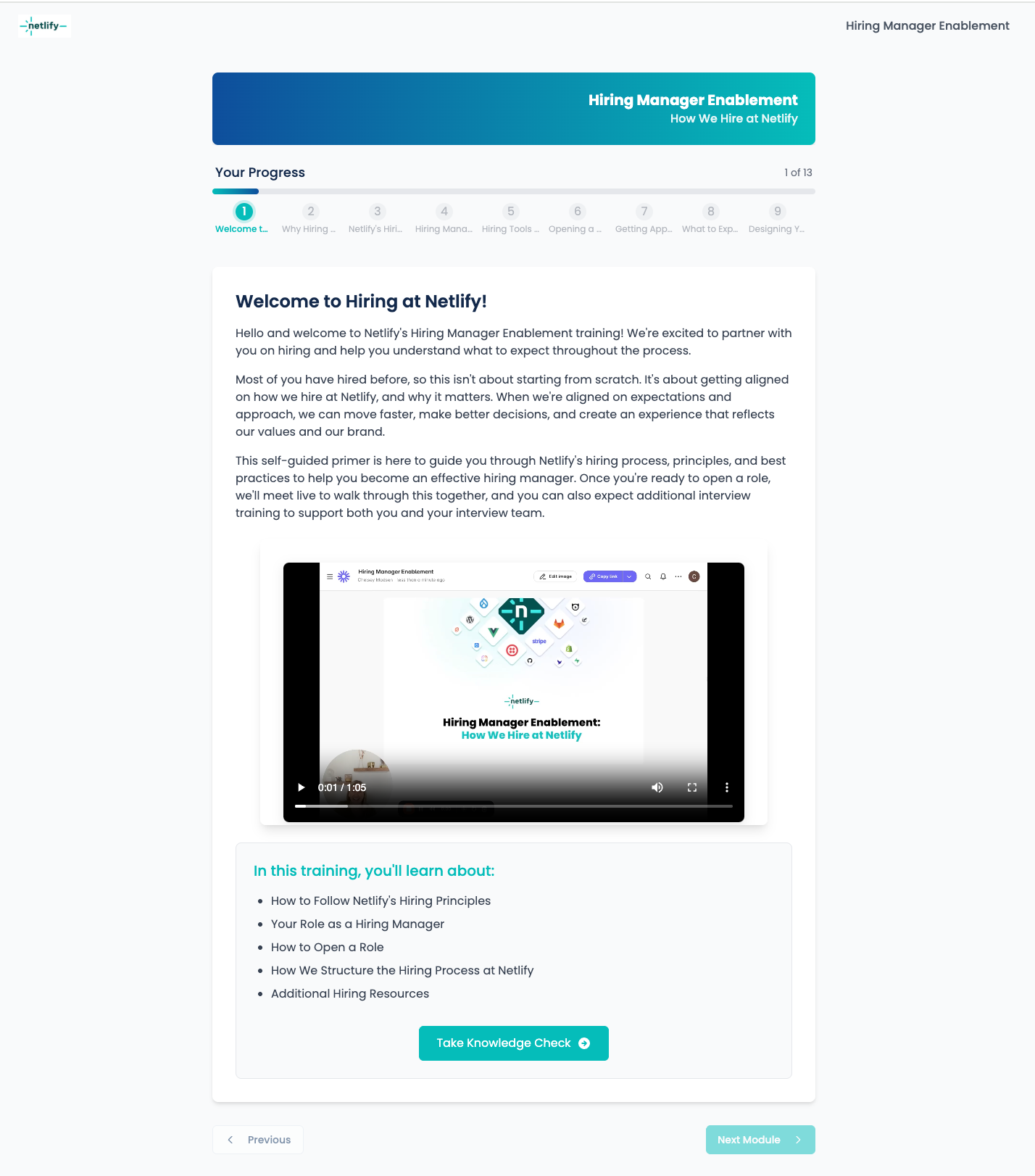
Through vibe coding, I was able to build an interactive, gamified self-service enablement tool that:
- Walks hiring managers through our team’s hiring fundamentals
- Includes embedded Loom videos
- Tests with interactive questions and trivia
With this tool, hiring managers can now self-serve on the basics before we ever hop on a call, so we’re not starting from zero in our first sync. We still revisit the content live since it’s not intended to be a substitute for partnership, just a precursor that raises the floor and ensures we have more time to focus on the nuanced, strategic aspects of building their team.
Building the tool taught me a lot. Embedding Loom videos and integrating analytics and forms introduced more technical complexity than I had expected, and there were plenty of frustrating moments. I spent hours guiding LLMs to help me generate the right code, and at several points, made edits directly in the code when I needed precise control. By the time it was ready to ship, it felt incredibly empowering. The idea that I was using the same tools that the engineers I hire are building felt gratifying and gave me a deeper appreciation for our product.
Hiring dashboard app
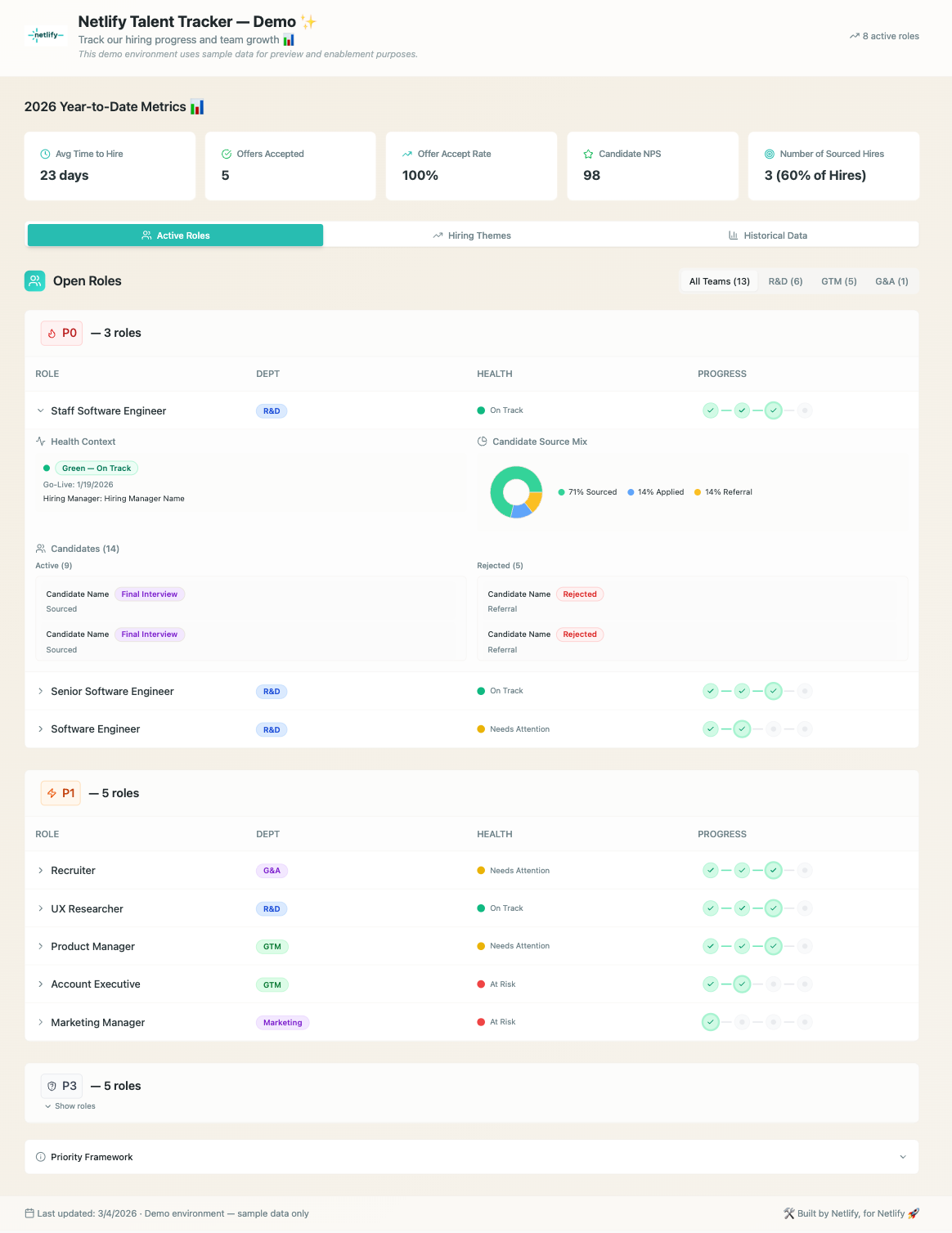
From there, I built a hiring dashboard. Before this, I didn’t have a clean way to share hiring data with leadership. If a leader wanted to know where their roles stood, or see hiring trends and year-to-date metrics, I was cobbling spreadsheets together manually, which could take hours away from my week. Now, they have a dashboard with everything at their fingertips - role & pipeline breakdowns, hiring themes, metrics, and data visualization all in one place. Leaders can get answers instantly, and I get my time back to focus on the hard problems, like how we’re attracting the right talent, what our hiring velocity signals about team health, and how we can forecast needs before they become bottlenecks. This has significantly changed my ability to show up in strategic conversations with leaders and present concrete data in a digestible way, not just sharing status updates.
Looking ahead, we’re working on more candidate-experience-forward experiments by building tools that give candidates a deeper view into what it’s like to work at Netlify, more robust interview enablement for hiring teams, and better intake processes.
Apps from the Business Partner & Ops Team
Kelly, our HRBP Director, saw a vibe coding opportunity early on.
“I kept thinking about all the tools we were paying for that didn’t quite fit our needs,” she told me. “What if we could build exactly what we wanted instead?”
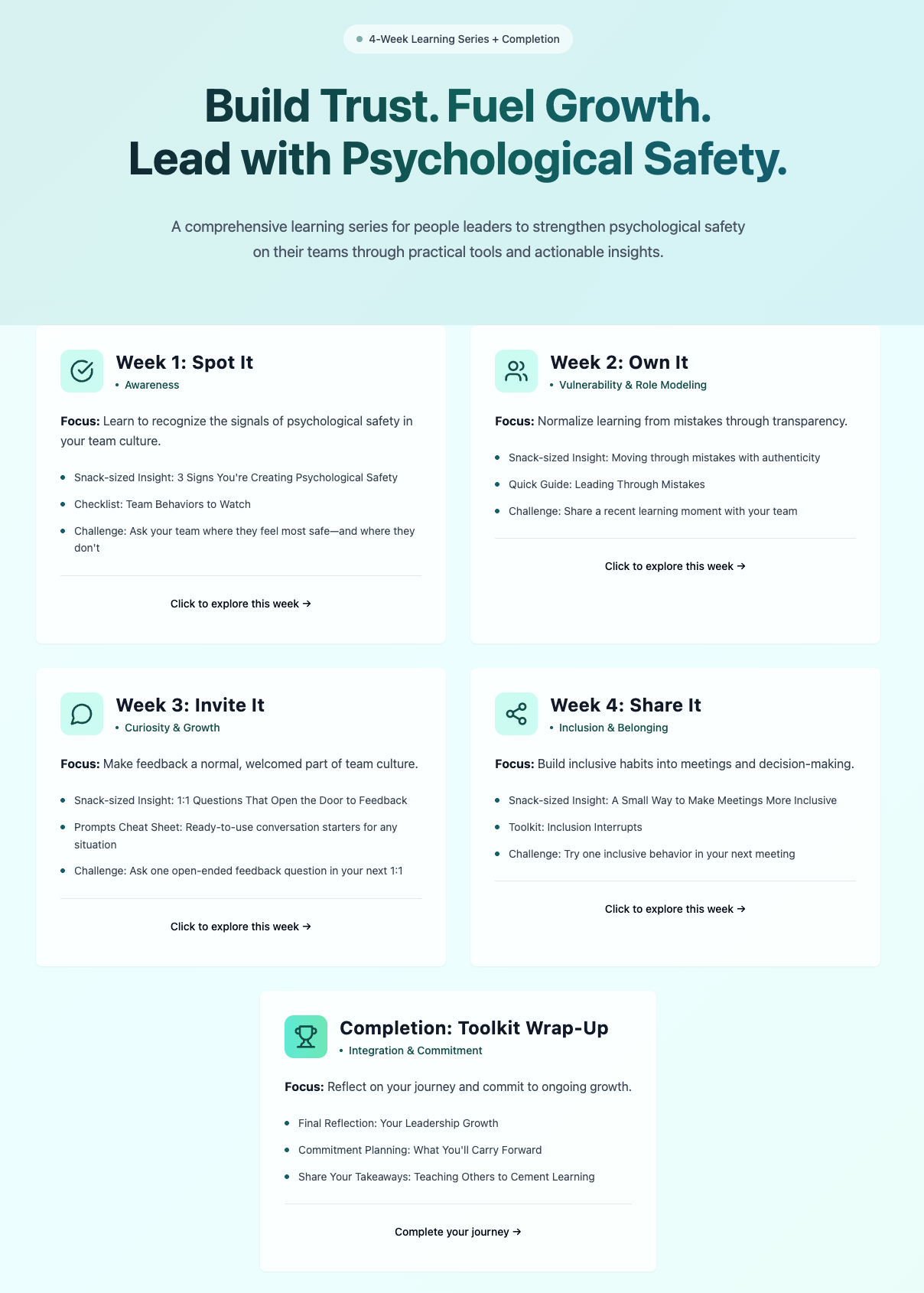
Her first project was a 4-week psychological safety learning series. The People team already ran a live leadership enablement session on the topic, but Kelly wanted a way to extend impact beyond a single workshop, something leaders could bring back to their teams. Using vibe coding tools and deploying on Netlify, she built a self-serve internal tool with practical tips, conversation starters, and space for reflection and documentation. Shipping that tool sparked a bigger question: what else could we build instead of buy?
Employee survey app
At the time, we were relying on a third-party survey tool, and it was expensive and rigid. Kelly saw an opening to do something different by building a custom made employee pulse survey tool that felt like Netlify - our vibe, our questions, and our need for fast, actionable insights. She then began vibe coding a robust employee sentiment survey tool that included both an employee-facing survey experience and an admin backend for deeper data analysis.
“The complexity of this project from a technical depth and data security perspective forced me out of my comfort zone in a good way,” Kelly said. “It meant pulling in PMs, engineers, and leaders across IT, Security and R&D, and suddenly this wasn’t an HR side project anymore. It was a collaborative effort we were solving for the company that we knew would benefit our customers as well.”
This project was also an excellent use case for Agent Runners, a Netlify feature that lets you update apps with AI prompts instead of working with code directly. Being able to make real updates through prompting directly in Netlify made it much easier for the team to iterate on the survey tool and share what they were learning back with the product team. It was satisfying to dogfood our own platform while improving it in the process.
The employee sentiment tool went live last quarter, and the data visualization and insights are now presented across all of leadership. Kelly is still iterating, but the impact is already clear. Instead of navigating third-party tool limitations, she’s spending her time where it matters most, through analyzing patterns, surfacing organizational signals, and partnering with leaders on what the data actually means for the business.
Employee onboarding app
On the ops side, Jasmine, our People Operations Partner, tackled onboarding documentation.
“Hiring employees across 12 countries meant we needed something way more accessible and easily digestible than our clunky Notion to-do lists.”
The vibe-coded onboarding tool Jasmine built helps new hires get up to speed more efficiently, saving hours of manual process and reducing the back-and-forth. It also brings new hires to the Netlify product faster, as the enhanced tool shows them that vibe coding is part of even our non-technical teams.
The onboarding tool now means new hires across 12 countries can get up to speed without waiting for someone in their timezone to walk them through basics, and frees Jasmine up to focus on strategic work on building belonging initiatives that work across our global teams, and setting our new hires up for success on our team from day one, not just checking boxes on a to-do list.
What we’ve learned & what’s next
The transformation isn’t just about having new tools - it’s about eliminating accumulated inefficiencies and fundamentally changing how we work. Manual status updates, awkward workarounds, and software that gets you 80% of the way there are micro-frictions that multiply across a distributed organization. We’re building infrastructure that empowers us to be systems designers now, not just operators, so we can spend our time on strategy, partnership, and the complex, human work that generic software can’t solve.
We’ve even formalized this approach by organizing monthly team meetings to scope new vibe coding projects and ran our first people team hackathons late last year, where our team experiments together. What started with dog sites is now part of how we operate! We’re still learning and figuring out where the boundaries are, while testing out new tools along the way. Vibe coding has given us the ability to build the infrastructure we need faster, without waiting for engineering resources or budget approval.
If you’re thinking about trying this yourself, here’s what we’d recommend:
- Start with low-stakes experiments. Our dog sites weren’t just fun, they were safe ways to learn without pressure.
- Partner with security and engineering from the start. Don’t wait until you’re ready to launch - bring them in as you build.
- Build with scale in mind. Even on a small team, think about how the tool will work when you’re not the only one using it.
If you’re on a small team looking for creative ways to work and want more control over the tools you use, this is worth exploring. Start small and see where it takes you!